
'They have started becoming an important player, but not at the same level as they were in the earlier part of the decade.'

Perhaps the finance ministry or NITI Aayog could take a detailed look at what governments actually deliver and at what cost; how their services can be improved and expanded where necessary; how much money can be saved through doing things differently; and how many things the government does which it can safely leave to the private sector, argues T N Ninan.

The early bird results for the January-March quarter of 2022-23 (Q4FY23) show a pick-up in earnings growth, despite a slowdown in revenue growth, thanks to a decline in input costs and lower provisioning for bad loans by banks. The combined net profit of 66 companies that have, so far, declared their quarterly results was up 15.2 per cent year-on-year (YoY) in Q4FY23, an improvement from 4.3 per cent YoY growth in Q3. Net sales growth of these companies, however, slowed down to 11.5 per cent YoY in January-March 2023, the slowest rate in eight quarters.

The Budget oration of the finance minister and the confidence with which she delivered it, along with the measures and the recent upsurge in the economy would all contribute to unleashing the storied 'animal spirits' and help the economy run on the growth path quite smoothly. Or so the government hopes, notes Shreekant Sambrani.

Prime Minister Narendra Modi asserted on Wednesday that his government's action against corruption has made some people angry but he will not turn back in this fight against graft and nepotism, however big an alliance his rivals form against him.

The total amount of money various entities have raised through the private placement route is at its lowest since 2014. They raised a total of Rs 1.96 trillion in the first five months of 2022, revealed the numbers from PRIME Database. It is down 23.4 per cent from the Rs 2.56 trillion raised in the corresponding period in 2021.

Seven of the meetings will be held in late November or early December at the finance ministry, as is the norm.

The tax authorities may tell banks and crypto exchanges to report transactions of virtual digital assets (VDAs) as the government begins taxing gains from cryptocurrencies and non-fungible tokens from April 1. So far, the tax department has relied on voluntary disclosures on transactions of VDAs. Once implemented, the sale and purchase of digital assets will reflect in the Annual Information Statement (AIS). The AIS contains details of at least 46 of the financial transactions done by a taxpayer in a financial year.

In absolute terms, revenue receipts stood at Rs 9.07 lakh crore at the end of October. For the entire 2019-20, the revenue receipts have been pegged at Rs 19.62 lakh crore.

The engineering and construction (E&C) sector delivered an excellent performance in the last two financial years (FY2021-22 or FY22 and FY23's nine-months) and there's reason to believe that FY24 will also see outperformance. The sector has emerged from the pandemic with stronger balance sheets and more rational cost structures. It has a big order book and it should see new order flows accelerate in FY24.

'That is the one headline the world is reading about India this week, and it is a potentially damaging story...' 'I don't think a panic mentality has set in, but this story is one that investors and market watchers are absolutely seized with.'

India's GDP growth will slow down to 5.5 per cent in FY24 from the 6.9 per cent expected in the current fiscal 2022-23, a Swiss brokerage said on Wednesday. The slowdown was attributed to slowing global growth and tightening of monetary policies in the report by economists at UBS India. It said India will be among the "lesser affected economies" in the world, but made it clear that the world's fifth largest economy is not immune from global headwinds.

According to reports, by last year, the company has helped its customers save 15 per cent on costs -- around 5-6 per cent on fuel and 15 per cent on fleet utilisation through digital measures.

'With Ramaland, the tourism department is looking to attract children and adults alike. It'll be learning with entertainment.'

Finance Minister Nirmala Sitharaman will present the much-awaited 2022-23 Union Budget on February 1. While there has been strong recovery in some sectors, touch services like hospitality, tourism and leisure continue to suffer after two Covid-19 waves. Household savings have been hit due to increased spending on health care. Consumption has still not reached pre-pandemic levels.

Spending through the credit card in March 2022 jumped 48 per cent year-on-year to top Rs 1 trillion -- five months after it had hit the same figure for the first time in October 2021, buoyed by festive season expenditure. The jump has been driven by the pickup in consumption as the pandemic recedes. Expenditure in March, at Rs 1.07 trillion, was up 24.5 per cent over February, the data put out by the Reserve Bank of India (RBI) showed.

'If private capex has to kick in, there should at least be 2-3 years of visibility.'

In a notification, the home ministry also said if the amount exceeds, the individuals will now have 90 days to inform the government instead of 30 days earlier.

Notwithstanding expectations of a pick-up in construction activity during a seasonally strong January-March quarter (fourth quarter) of 2022-23 (FY23), analysts are cautiously optimistic about the building material sector - encompassing paints, pipes, wood panels, tiles, metals, and cement - as volatile input costs, coupled with fears of a global slowdown, are making demand projections uncertain. Against this backdrop, analysts suggest investors stay selective and pick stocks of companies with stronger brand recall, expanding distribution network, diversified product profile, healthier balance sheet, and sustainable cash flow. "The government's various proposals under Budget 2023-24 (FY24) may lead to the building material segment growing between 8 per cent and 12 per cent for the next five years.

The dream-run in railway stocks may soon run out of steam, caution analysts. The rally, which has lasted nearly a year, may meet time-wise correction post the Union Budget announcements as investors begin scalping profits. "There is going to be a build-up in expectations for the sector from the Union Budget, which is still two-odd months away.

The finance ministry will kick-start the exercise to prepare the annual Budget for 2023-24 from October 10, in the backdrop of revival of the Indian economy and fears of recession in developed countries. The budget for the next year will have to address critical issues of high inflation, job creation, boosting demand, and putting the economy on a sustained 8 per cent-plus growth path. On Wednesday, finance minister Nirmala Sitharaman said inflation is no longer "red-lettered" and the priority for the government now is job creation and boosting growth.

Given the many policy areas where the Centre and the states have not been seeing eye to eye in the last few years, it is time the Modi government convenes a meeting of the Inter-State Council, recommends A K Bhattacharya.
The external environment has worsened further. While the Finnish economy entered into a recession, Swedish economic growth also dipped. The Finnish gross domestic product (GDP) dropped 0.6 per cent in October-December, 2022. It was the second quarter of negative growth, which is a technical definition of recession.

This is not her first stint in North Block or in leading a major economic ministry. She started Prime Minister Narendra Modi's first term as minister of state for finance, was made the commerce minister, and then became the defence minister.

Every patriot should learn from our history and recognise that celebrating size will neither negate nor obscure the huge economic challenges that India faces, asserts Rathin Roy.

Finance Minister Nirmala Sitharaman on Monday said the government estimates fiscal deficit of 6.8 per cent of the gross domestic product (GDP) in the next financial year beginning April 1. However, the fiscal deficit in 2020-21 is estimated to soar up to 9.5 per cent due to rise in expenditure on account of the outbreak of COVID-19 and moderation in revenue during this fiscal year.

The Union government's fiscal deficit further widened to Rs 9.53 lakh crore, which is nearly 120 per cent of the annual budget estimate, at the end of October of the current financial year, according to official data released on Friday. The deficit widened mainly on account of poor revenue realisation. The lockdown imposed to curb spreading of coronavirus infections had significantly impacted business activities and in turn contributed to sluggish revenue realisation.

After clocking losses for seven straight quarters, Tata Motors on Wednesday posted a consolidated net profit of Rs 3,043 crore in the third quarter (Q3) of 2022-23. This came on the back of a strong order book, better semiconductor chip supply, tempered commodity prices, and a better product mix. "We remain cautiously optimistic about the demand situation, notwithstanding the global uncertainty.
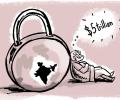
In order to achieve $5 trillion GDP by FY'25, India needs to spend about $1.4 trillion over this period on infrastructure, according to the Economic Survey. During financial years 2008-17, India pumped in about $1.1 trillion on infrastructure. However, the challenge is to step up infrastructure investment substantially, the Economic Survey 2021-22 said.

Do the actual numbers bear out the claims made by the government or do they suggest something else? asks A K Bhattacharya.

'Recent underperformance notwithstanding, equities should constitute a major part of investors' financial portfolio.'

Rating agencies Crisil and Icra on Monday revised down their India growth projections for the current fiscal and the second quarter mainly due to the ripple effect of slowdown in global growth and mixed crop output. Crisil downgraded the India growth forecast by 30 bps to 7 per cent while Icra pegged the economic expansion at 6.5 per cent for the second quarter of FY2022-23. "We have revised down our forecast for real gross domestic product growth to 7 per cent for fiscal 2023 from 7.3 per cent, primarily because of the slowdown in global growth that has started to impact our exports and industrial activity.

If Kerala wants to sustain its room for independent thinking and talk back to Delhi when needed, it should put its finances in order. Or - if one takes the North East example - Kerala's political posturing may end up commensurate with its financial dependence on others, suggests Shyam G Menon.

For all its claims to economic glory, the majority of India's population lives vulnerable lives, a situation that has only worsened over the past 15 years, to the extent that the government now fears to release economic data or even conduct a proper Census, notes Rathin Roy.

Senior tax officials were told to focus on cash collection from the arrears so that the target for FY23 was achieved and the overall revenue position improved.

The Union Cabinet on Wednesday approved restoration and continuation of the Member of Parliament Local Area Development Scheme (MPLADS), which was suspended in view of the Covid-19 pandemic.

'India seems to be on a relatively better wicket compared to other emerging markets.'
The Centre has cleared the entire GST compensation payable till date by releasing Rs 86,912 crore to states, the finance ministry said on Tuesday. Of this, Rs 25,000 crore is released from the GST compensation fund and the balance Rs 61,912 crore is being released by the Centre from its own resources pending collection of cess. Of the total compensation released, Rs 17,973 crore is towards April and May dues, Rs 21,322 crore towards February-March dues and Rs 47,617 crore is the balance of compensation payable up to January 2022.

Finance Minister Nirmala Sitharaman on Tuesday met IMF managing director Kristalina Georgieva and discussed a range of issues, including impact of geopolitical situation on global growth.

Markets regulator Sebi has reduced the minimum lock-in period for promoters' investment post an initial public offering (IPO) to 18 months from three years, under certain conditions. The move comes at a time when many companies are looking to list on the stock exchanges. In addition, the Securities and Exchange Board of India (Sebi) has streamlined disclosures requirements of group companies.
